
ASCE 7-22 establishes minimum design loads and associated criteria for buildings and other structures in the United States. Published by the American Society of Civil Engineers (ASCE) and its Structural Engineering Institute (SEI), the standard addresses structural demands arising from gravity, wind, earthquakes, snow, flooding, tornadoes, and other hazards.
The 2022 edition, formally titled Minimum Design Loads and Associated Criteria for Buildings and Other Structures, replaced ASCE 7-16 and introduced substantial revisions to hazard assessment and structural design procedures.
For engineers, architects, building officials, and infrastructure professionals, understanding ASCE 7-22 involves more than identifying individual load values. Its provisions establish how loads are determined, combined, and evaluated against structural performance requirements.
The standard is available as a complete commercial PDF, in print, and through digital access. A separate introductory PDF and the free ASCE Hazard Tool provide useful supporting information, although neither replaces the complete standard.
What Is ASCE 7-22?
ASCE 7-22 is a nationally recognized structural loading standard that establishes minimum requirements for determining environmental, occupancy-related, and other loads acting on buildings and structures.
The document provides a consistent framework for structural design across different materials and construction systems. Engineers use its provisions to establish design actions before evaluating members, connections, foundations, and lateral-force-resisting systems under applicable material standards.
Its requirements address two fundamental aspects of structural performance: strength and serviceability.
Strength provisions help establish whether a structure can resist prescribed loads and combinations. Serviceability considerations address performance characteristics such as deflection, drift, and other responses that may affect a building’s intended function.
The standard also incorporates risk-based design principles. Buildings with different occupancy classifications and consequences of failure may be subject to different hazard levels and design requirements.
A facility intended to provide essential services during an emergency, for example, can face different structural design criteria from an ordinary commercial building.
ASCE 7-22 establishes the loading framework, while the applicable building code and other referenced standards determine the complete set of requirements for a particular project.
Design Loads Covered by ASCE 7-22
A building must resist several types of loading throughout its service life. Some remain relatively constant, while others vary with occupancy, environmental conditions, or extreme events.
ASCE 7-22 addresses these demands through dedicated provisions and prescribed load combinations.
| Load category | Design considerations |
| Dead loads | Permanent structural components, fixed equipment, and building materials |
| Live loads | Occupants, furniture, movable equipment, and occupancy-related loading |
| Wind loads | Wind pressure on structural systems, roofs, walls, and components |
| Seismic loads | Earthquake-induced forces and structural response |
| Snow loads | Ground snow, roof accumulation, drifting, and unbalanced loading |
| Rain loads | Roof drainage, water accumulation, and ponding effects |
| Flood loads | Hydrostatic, hydrodynamic, and other applicable flood-related actions |
| Tsunami loads | Coastal inundation and associated structural demands |
| Atmospheric ice | Ice accumulation and concurrent environmental loading |
| Soil and groundwater | Earth pressure and applicable groundwater effects |
| Tornado loads | Extreme wind actions for structures within the provisions’ scope |
Fire-related criteria and extraordinary loading considerations also form part of the broader standard.
The presence of a load category does not mean every project must undergo an identical analysis.
A conventional inland building may require extensive snow and seismic evaluation but have no applicable tsunami design requirement. A coastal facility can face additional flood or tsunami considerations depending on its location and classification.
For New England projects, snow accumulation, wind exposure, seismic conditions, coastal flooding, and roof drainage can be particularly relevant.
The governing requirements still depend on the specific site, building configuration, risk category, and adopted code.
Understanding Load Combinations
Structures rarely experience design loads independently.
A roof may carry permanent weight and snow while simultaneously experiencing wind effects. Earthquake loading may act alongside gravity loads, and certain environmental actions can create both downward and uplift demands.
ASCE 7-22 prescribes combinations that account for these interactions.
Strength design and allowable stress design use different combinations and evaluation procedures. Engineers must select the appropriate method and apply the relevant factors and companion loads.
Simply adding the maximum value of every possible load together is generally not the prescribed approach. The standard defines combinations to represent applicable loading scenarios while maintaining the intended reliability.
Major Changes Introduced in ASCE 7-22
The transition from ASCE 7-16 to ASCE 7-22 involved significant revisions across several hazard categories and structural systems.
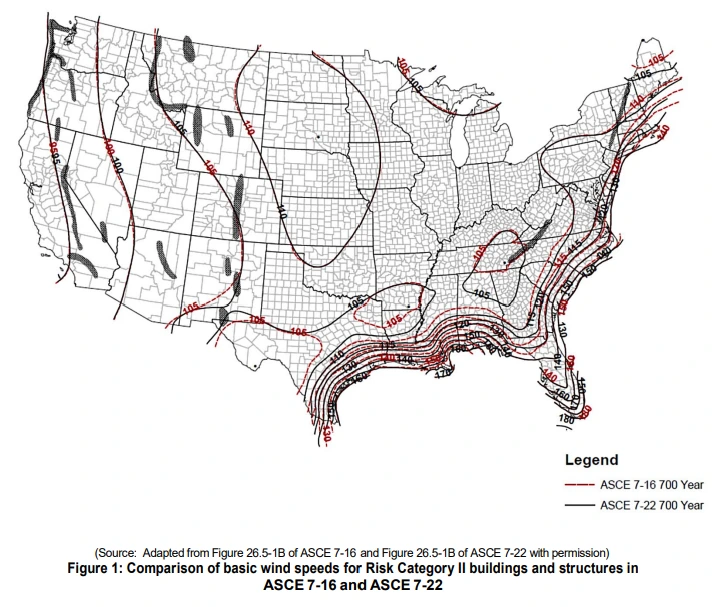
Some changes update environmental hazard data. Others introduce new analysis methods or extend provisions to structural configurations that previously required additional interpretation.
New Tornado Design Provisions
One of the most significant additions is a dedicated chapter addressing tornado loads.
The provisions establish tornado-related design criteria for applicable structures and introduce hazard information associated with different risk and exposure conditions.
This development gives engineers a standardized approach to a hazard that previously received less explicit treatment in general building design requirements.
Tornado design does not automatically apply to every building in the United States. Its applicability depends on factors including geographic location, risk category, and the standard’s specified criteria.
For qualifying projects, engineers must determine the appropriate tornado hazard parameters and apply the corresponding design requirements.
Revised Snow Load Methodology
ASCE 7-22 updates ground snow load information using more recent data and reliability-targeted values.
The revisions also modify procedures for evaluating snow drifting, including consideration of a winter wind parameter.
These changes matter for buildings with complex roof geometry, adjacent structures, parapets, and areas where snow can accumulate unevenly.
A warehouse with a lower roof beside a taller building illustrates the concern. Wind can transport snow from one roof area to another, creating concentrated loading that differs substantially from a uniform roof snow load.
Engineers must evaluate the applicable drift conditions using the current provisions.
For projects originally developed under ASCE 7-16, transitioning to ASCE 7-22 may therefore require more than replacing an old ground snow load with a new value.
The full calculation procedure needs review.
Updated Seismic Design Criteria
The standard introduces multi-period response spectrum data and revises elements of seismic hazard determination.
These changes affect how engineers establish earthquake design demands and evaluate structural response.
The revised framework also includes additional lateral-force-resisting systems, including certain coupled shear wall configurations and cross-laminated timber shear walls.
Such provisions provide defined design pathways for structural systems that have become increasingly relevant in contemporary construction.
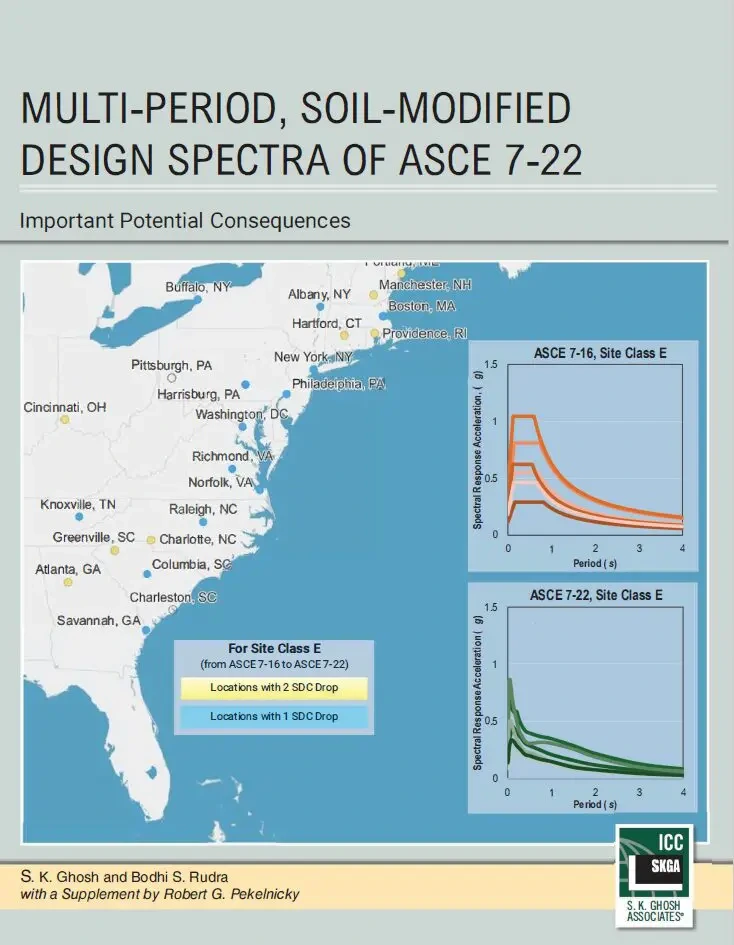
However, seismic requirements cannot be evaluated using hazard maps alone.
Site conditions, structural configuration, risk category, response characteristics, and the applicable building code all influence the final design approach.
Wind, Rain and Ice Revisions
ASCE 7-22 updates wind provisions affecting main wind-force-resisting systems and components and cladding, including requirements relevant to elevated buildings.
Rain load revisions explicitly address ponding head, an important consideration when water accumulates on roofs.
Atmospheric ice provisions introduce risk-targeted hazard information for the continental United States and Alaska.
Additional revisions address tsunami loading, groundwater effects, emergency vehicle loads, and certain nonbuilding structures.
Taken together, these changes broaden the standard’s treatment of environmental hazards and specialized structural conditions.
ASCE 7-22 and Building Code Adoption
Publication of an engineering standard does not automatically make it legally enforceable in every jurisdiction.
ASCE 7 becomes applicable through adoption by building codes and other governing requirements.
The 2024 International Building Code references ASCE 7-22, while the 2021 edition generally references ASCE 7-16 with its applicable provisions and modifications.
Differences between the standard and the adopted building code must be considered, particularly where the code modifies specific requirements.
For a project beginning in 2026, the relevant question is therefore not simply whether ASCE 7-22 is available.
Engineers must establish which building code edition has been adopted by the jurisdiction, whether local amendments apply, and which edition of ASCE 7 that code references.
This distinction is especially important for regional infrastructure development.
Massachusetts, Connecticut, Rhode Island, New Hampshire, Vermont, and Maine have separate regulatory frameworks. Requirements can also vary according to project type and the authority responsible for enforcement.
An appropriate compliance review should establish:
- The adopted building code and applicable local amendments.
- The referenced ASCE 7 edition.
- The project’s occupancy and risk classification.
- Applicable environmental and site-specific hazards.
- Relevant exceptions, supplements, and other referenced standards.
Where the adopted code modifies ASCE 7 requirements, the governing code provisions must be followed.
Using the newest published edition without confirming its legal applicability can introduce errors into construction documents and regulatory submissions.
ASCE 7-22 PDF: Available Formats and Access
Engineers searching for an ASCE 7-22 PDF should distinguish the complete technical publication from supporting documents.
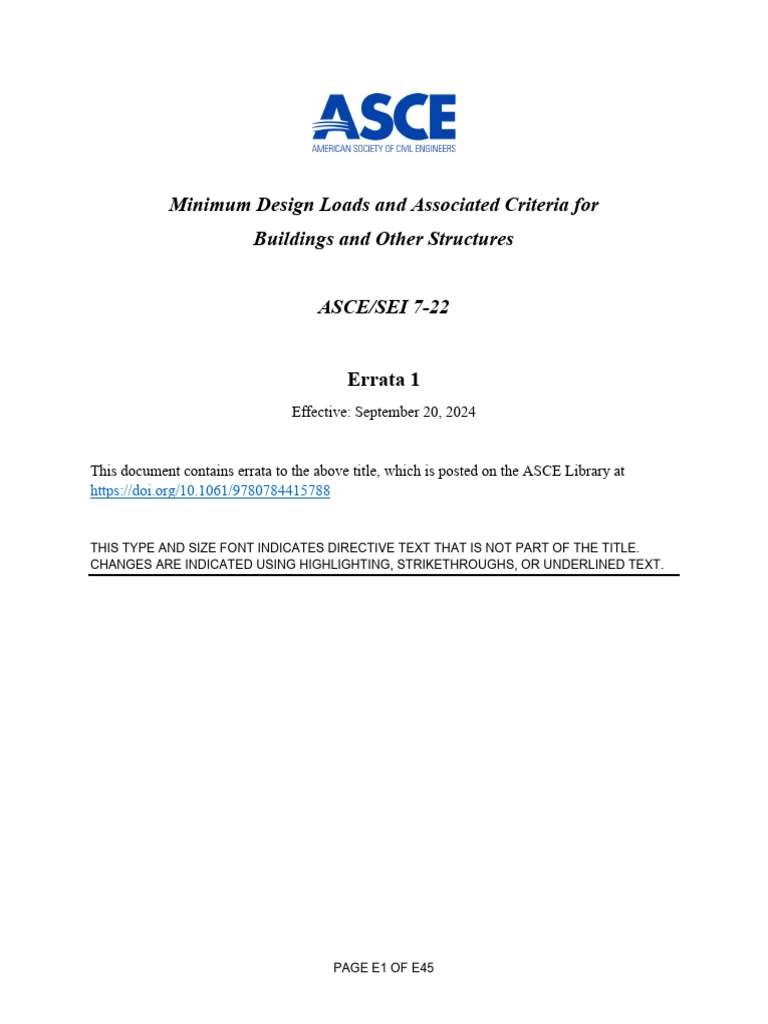
The full standard is a commercial publication available in several formats.
| Format | What it provides |
| Official PDF | Complete digital publication containing the standard |
| Printed edition | Physical reference for engineering offices and field consultation |
| ASCE AMPLIFY | Interactive digital access through the publisher’s platform |
| Introduction PDF | Overview of the standard and its principal features |
| Supplements and errata | Published amendments and corrections to specific provisions |
The introductory document is useful for understanding the standard’s scope and changes, but it is not a substitute for the complete text.
The free ASCE Hazard Tool also produces PDF reports. These contain location-specific hazard information rather than the complete standard.
As of September 2026, ASCE lists three supplements and published errata for ASCE 7-22.
Engineers obtaining a copy should check whether these documents apply to their project and confirm any requirements imposed by the adopted building code.
For professional use, obtaining the publication through authorized distribution channels helps establish which edition and supporting documents are being consulted.
An unidentified PDF circulating online may contain an outdated printing, omit amendments, or provide incomplete material.
How the ASCE Hazard Tool Works
The ASCE Hazard Tool provides geographic hazard information used with ASCE structural design standards.
Its mapping interface allows users to select a project location and retrieve environmental parameters associated with the selected standard edition.
The tool supports eight hazard categories:
- Seismic
- Wind
- Tornado
- Atmospheric ice
- Rain
- Flood
- Snow
- Tsunami
Users can enter an address, provide geographic coordinates, or identify a location through the map interface.
After selecting the appropriate standard edition, the system displays available design parameters for that location.
For example, an engineer evaluating a proposed building in northern Massachusetts can retrieve relevant snow, wind, and seismic hazard information.
The results provide a starting point for calculating design loads under the applicable provisions.
The tool also allows users to generate PDF reports documenting the selected location and hazard information.
These reports can support preliminary engineering assessments, project records, and technical discussions.
However, obtaining hazard parameters does not complete the structural design process.
Engineers must still evaluate building geometry, exposure conditions, site characteristics, structural systems, applicable load combinations, and other project-specific requirements.
The Hazard Tool is free to use, while access to the complete ASCE 7-22 publication is provided separately.
What Engineers Should Verify Before Using ASCE 7-22
The most consequential errors in applying structural loading standards often arise before detailed calculations begin.
An incorrect code edition, project classification, or hazard parameter can affect every subsequent design decision.
For new projects, the starting point should be a documented basis of design identifying the applicable code, referenced standards, loading assumptions, and site information.
Engineers should then confirm that the selected hazard data corresponds to the intended edition.
A hazard report generated using ASCE 7-22 should not be transferred into an ASCE 7-16 calculation without evaluating the differences between editions.
The same principle applies to older calculation templates and structural analysis software.
Software may contain updated hazard databases while retaining assumptions, procedures, or default settings associated with earlier standards.
Calculation outputs therefore require independent review against the governing requirements.
For existing buildings, the appropriate design or evaluation standard also depends on the nature of the proposed work. Alterations, additions, and seismic evaluations may be governed by separate provisions.
ASCE 7-22 provides the loading framework for applicable work, but it does not replace engineering judgment, project-specific investigation, or the requirements of the authority having jurisdiction.
The practical starting point is to confirm the governing code edition, obtain the applicable standard and amendments, and document the project-specific hazard parameters before beginning structural calculations.